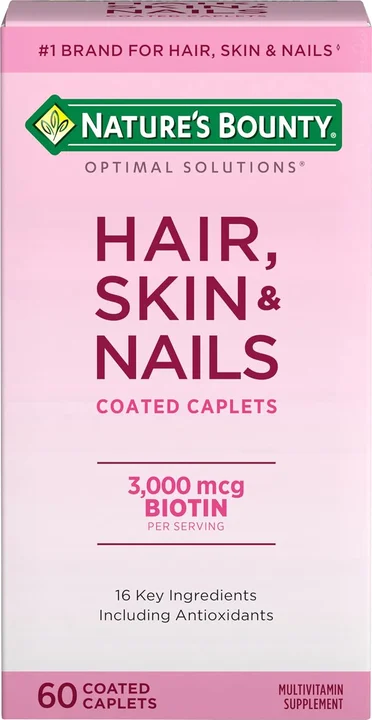
Nature's Bounty Hair, Skin & Nails, 3,000 mcg Biotin Caplets
A long-running, biotin-anchored multivitamin from a household supplement brand. Every active is individually disclosed with an exact amount and %DV — there's no hidden blend here, though the evidence behind the "hair, skin, nails" positioning is more modest than the name suggests.
What it's made of
The labeled serving is three coated caplets, taken daily with a meal. Biotin is the headline active at 3,000 mcg (10,000% of the Daily Value), sitting inside a broader multivitamin/mineral panel that includes vitamin A, vitamin C (60 mg), vitamin D3, vitamin E (6.7 mg), a full B-complex, calcium, zinc, and smaller amounts of PABA, choline, inositol, a citrus bioflavonoid/rutin complex, horsetail powder, and hydrolyzed collagen (50 mg). Every one of those is listed with an exact amount and %DV on the label — a proprietary-blend product would list a single combined weight with no individual breakdown, which this does not do. The label states the product is gluten-free, with no artificial color or flavor, no added sugar, and no milk or shellfish.
Per 3-caplet serving
Biotin 3,000 mcg (10,000% DV), plus a full multivitamin/mineral panel including vitamin C, vitamin E, zinc, and 50 mg hydrolyzed collagen — all individually disclosed.
Label claims
Gluten-free, no artificial color/flavor, no added sugar, sodium-free. No third-party purity/potency seal (e.g. USP) disclosed on this listing.
What the real evidence shows
Per the NIH Office of Dietary Supplements, biotin is a B-vitamin that helps the body's enzymes metabolize fats, carbohydrates, and proteins, and true biotin deficiency (which is rare in the US) can cause thinning hair and brittle nails among other symptoms. NIH ODS is direct about the popular claim on products like this one, though: dietary supplements containing biotin are widely marketed to improve hair, skin, and nail health, but there is little scientific evidence to support that claim in people who aren't actually biotin-deficient. A handful of small studies found that people with pre-existing thin or brittle nails had harder nails after taking high-dose biotin — a specific, limited finding, not general proof that more biotin improves hair or skin for a typical, non-deficient adult. So biotin here is best understood as a normal-metabolism-supporting B-vitamin at a well-disclosed dose, not a proven cosmetic treatment.
One more thing worth knowing: the FDA has issued a safety communication noting that high-dose biotin, like the 3,000 mcg in a full serving of this product, can interfere with certain lab tests — including some troponin tests used to diagnose heart attacks — by producing falsely normal or falsely abnormal results. It's a real, FDA-flagged interaction worth mentioning to any doctor or lab before bloodwork, not a reason to avoid the product outright.
Who this is and isn't for
This suits someone who wants a transparently labeled, biotin-forward multivitamin from an established brand and understands that the hair/skin/nail benefit is realistically most likely for someone who's actually running low on biotin — it isn't guaranteed to work as a cosmetic upgrade for everyone. It's not the right choice for someone with upcoming bloodwork who hasn't told their doctor they're taking a high-dose biotin supplement, and because it's a fuller multivitamin (not an isolated single ingredient), anyone already taking a separate multivitamin should check for overlap before stacking the two.
NIH Office of Dietary Supplements, "Biotin — Fact Sheet for Consumers"
Harvard Health Publishing (Harvard Medical School), summarizing the FDA safety communication on biotin's interference with certain lab tests: "Biotin may throw off lab test results"
Product label and supplement facts as disclosed on the manufacturer and retailer listing: naturesbounty.com and amazon.com product listing