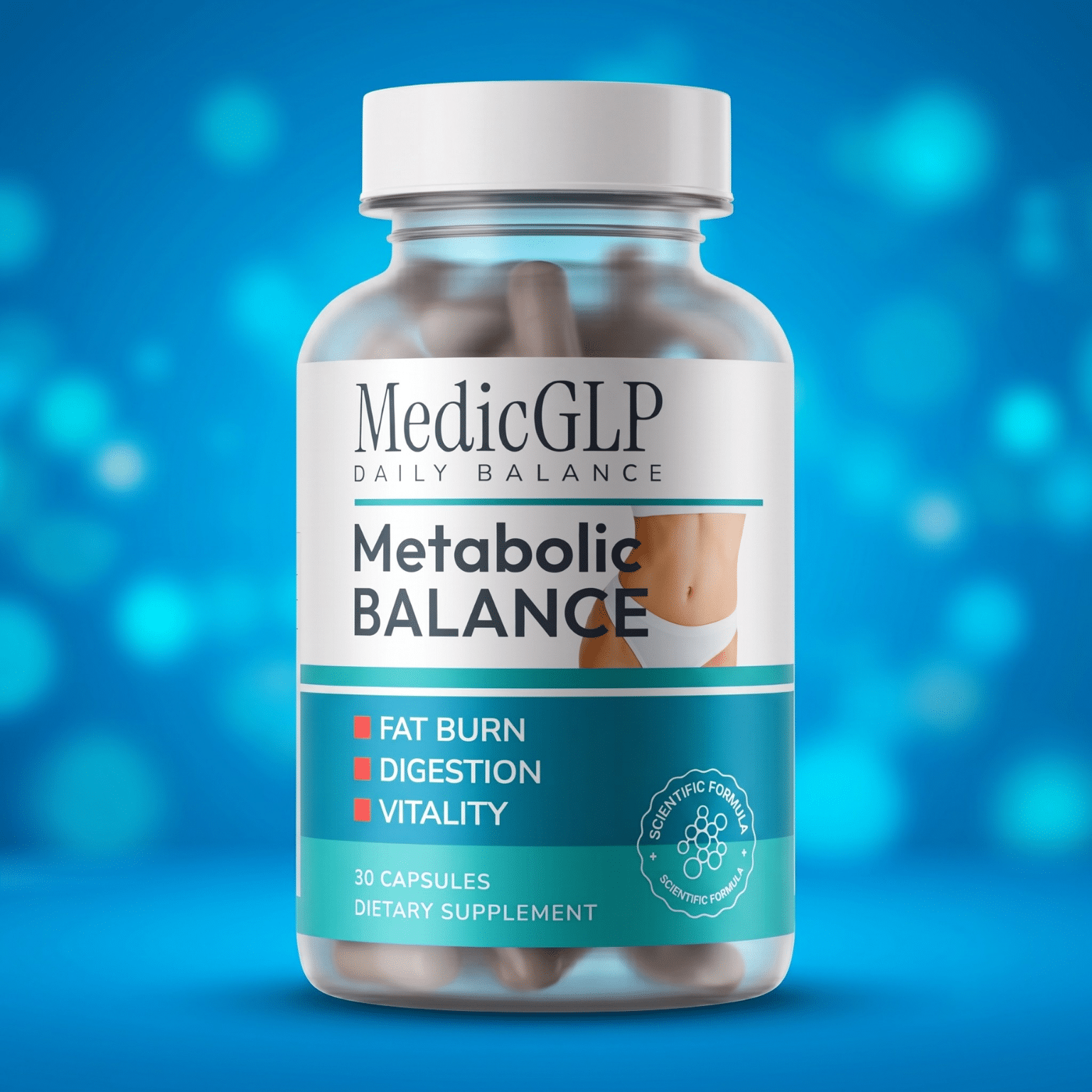
MedicGLP
MedicGLP is a plant-and-mineral capsule marketed for everyday metabolic and weight-management support. This report covers what the brand's own disclosures actually say — ingredients, pricing, guarantee terms — and where those disclosures fall short of a confident recommendation.
We link to Amazon and other authorized retailers and may earn a commission at no extra cost to you.The site's own legal notice names a content publisher — a sole proprietorship in Paris — but that notice explicitly states this entity does not sell the product, and directs order-related inquiries to a separate third-party support portal. We could not find a registered company name, business registration number, or VAT ID anywhere on the site that actually runs checkout.
The bottle price we found for the same product ranged from roughly €37 to €50 depending on which of the brand's marketing domains we checked, on top of a promotional "percent off" framing that changes by source. An independently reported customer complaint also describes a discounted checkout price that didn't match the amount actually charged.
This product is sold only through the brand's own checkout — it is not listed on Amazon and does not appear to be stocked by licensed pharmacies. That means there's no independent retailer, standardized buyer-protection process, or third-party review moderation you can cross-check the transaction against.
Independently reported customer feedback describes additional offers presented during checkout and confusion over whether an order had gone through. We could not verify individual accounts, but the same pattern shows up across more than one independent report.
What it claims
MedicGLP is presented as an all-natural, non-GMO capsule blend meant to support metabolism and appetite regulation "as part of a balanced lifestyle," alongside general weight-management goals. The on-page marketing copy we reviewed frames it as a plant-and-mineral formula rather than making any specific clinical claim, and it advertises a 30-day money-back guarantee. Directions differ by source: one version of the brand's materials describes one capsule per day covering a 30-day bottle, while another describes two capsules per day — we flag that inconsistency below rather than guess which is correct.
We did not find any explicit reference on the pages we reviewed to prescription weight-management medications or drug classes, and none appears in the copy quoted in this report.
What's actually disclosed
The formula discloses eleven active ingredients with specific per-dose amounts — most over-the-counter metabolic-support blends disclose far less than this, which is a genuine point in its favor. Transcribed as listed:
Chromium picolinate — 100 mcg
A mineral commonly included in metabolic-support blends for its role as an insulin cofactor. Evidence for a meaningful weight-management effect at typical over-the-counter doses is limited.
Green tea leaf extract (EGCG) — 154 mg
Contains naturally occurring caffeine and catechins studied for effects on metabolic rate; trial effect sizes are generally modest.
Apple cider vinegar — 150 mg
Listed as an encapsulated extract. Most existing research used liquid vinegar dosing, not a capsule extract at this amount, so those results don't directly transfer.
Berberine HCl — 85 mg
A compound studied mainly for glucose and lipid metabolism markers, typically at research doses of 500 mg or more per dose, taken multiple times daily — well above what's included here.
Ginger root — 50 mg
A traditional digestive-support botanical; included at a modest, commonly used amount.
Cinnamon bark extract — 20 mg
Included at a small fraction of the amounts used in most cinnamon/blood-sugar research.
Bitter orange fruit extract — 20 mg
Contains synephrine, a stimulant compound. Worth noting for anyone sensitive to stimulants or already taking caffeine or other stimulant products.
Cayenne pepper fruit — 20 mg
Contains capsaicin, another mild thermogenic/stimulant-adjacent compound — stacked here with caffeine and synephrine rather than used alone.
Banaba leaf extract — 5 mg
A botanical traditionally associated with blood-sugar support; included at a low amount relative to most standalone research.
Korean ginseng — 5 mg
A fraction of the doses used in most ginseng research, which commonly runs from several hundred milligrams up to multiple grams.
Resveratrol — 1 mg
Far below the amounts (typically 100 mg or more) used in human resveratrol research — this reads as a label-listing amount rather than a functional dose.
Capsule shell is listed as HPMC (hydroxypropylmethylcellulose), a plant-based, non-gelatin material.
A note on stacking: three of the eleven ingredients here are stimulant or stimulant-adjacent (caffeine from the green tea extract, synephrine from bitter orange, capsaicin from cayenne). Combining several at once is a real consideration for anyone stimulant-sensitive, pregnant or nursing, or already taking other caffeine or stimulant-containing products — this is a reason to check with a healthcare professional before use, not a reason to avoid the product outright.
Red flags found
Beyond the four items summarized above, two things are worth spelling out. First, the company structure is genuinely hard to pin down: the content site's own legal page names only a publisher who explicitly isn't the seller, and separate reporting we found (not something we could independently confirm by direct access) points to a Netherlands-registered holding entity and a Cyprus-registered fulfillment entity behind the actual transaction. We're not asserting that structure as confirmed fact — we're flagging that it's difficult for an ordinary buyer to determine who they're actually contracting with, which is itself the concern.
Second, this general product category — capsule supplements marketed around metabolic/appetite support and named or branded to evoke prescription weight-management drugs — has well-documented, industry-wide problems with AI-generated "deepfake doctor" endorsement ads used to drive traffic to unrelated storefronts. We found no evidence tying MedicGLP specifically to that tactic, and we are not claiming it uses one; we note it only as category-level context for why we're being more conservative than usual here.
Evidence for the ingredients
Individually, most of these ingredients have some published research behind them — berberine and green tea catechins on glucose/lipid metabolism markers, chromium picolinate on insulin cofactor activity, apple cider vinegar and cinnamon on blood-sugar-adjacent measures. That research is real, but it comes with real caveats: study sizes are often small, results are mixed between trials, and — as noted ingredient by ingredient above — several of the doses used in that research are meaningfully higher than what's in this specific formula (berberine and Korean ginseng in particular).
We found no independently registered clinical trial of the finished MedicGLP formula itself, only ingredient-level research on some of its individual components. That's a distinction worth keeping in mind: evidence for an ingredient in isolation, at a study dose, is not the same as evidence for this specific blend at these specific amounts.
Made-in-USA claim, bundle pricing & shipping — re-verified
"Made in the USA" claim
Not found. Re-checking medicglp.fr directly, the page does not state a country of manufacture at all — no "Made in the USA," "Made in France," or equivalent claim anywhere in the content we reviewed. Given the seller-of-record confusion already noted above, we'd treat the absence of any origin claim as one more disclosure gap rather than assume U.S. manufacture.
Bundle pricing — a real conflict, not a clean table
Re-checking medicglp.fr's own current page directly, we found: 1 flacon at €49.95 (€49.95/unit), 2 flacons at €79.95 (€39.97/unit), and 3 flacons at €109.95 (€36.65/unit) — consistent with what earlier research found on this same domain. But this is not the only price this product has been sold at: a separate aggregator site previously cited €39.95 for a single bottle, which doesn't match the vendor's own €49.95 single-unit price, and an independently reported Trustpilot complaint describes a customer who was shown an advertised €36.75 at checkout but was actually charged €109.95. We're stating all of this plainly rather than picking one number as "the" price, because the sources genuinely disagree and we have no way to determine which price a given buyer would actually be charged.
Free shipping — not disclosed
We found no mention of free shipping, shipping cost, or shipping terms anywhere on the medicglp.fr page we reviewed. We're not assuming shipping is free on any tier just because it isn't mentioned — this is an undisclosed cost a buyer would only learn at checkout.
If you'd rather buy through a standard retail channel
MedicGLP isn't available on Amazon or through licensed pharmacies, so there's no way to buy it through a channel with standardized buyer protections. If you want to explore some of the same individual ingredients through an established, longer-track-record brand instead, chromium picolinate and berberine are both sold separately on Amazon. These are single-ingredient products, not a substitute for MedicGLP's full blend or its specific dosing — just a lower-friction way to try the same ingredient category with a standard return process.
See chromium picolinate on Amazon See berberine on AmazonAs an Amazon Associate, we earn from qualifying purchases. Prices and availability change — check the listing before buying. Talk to a healthcare professional before combining supplements, especially stimulant-containing ones.