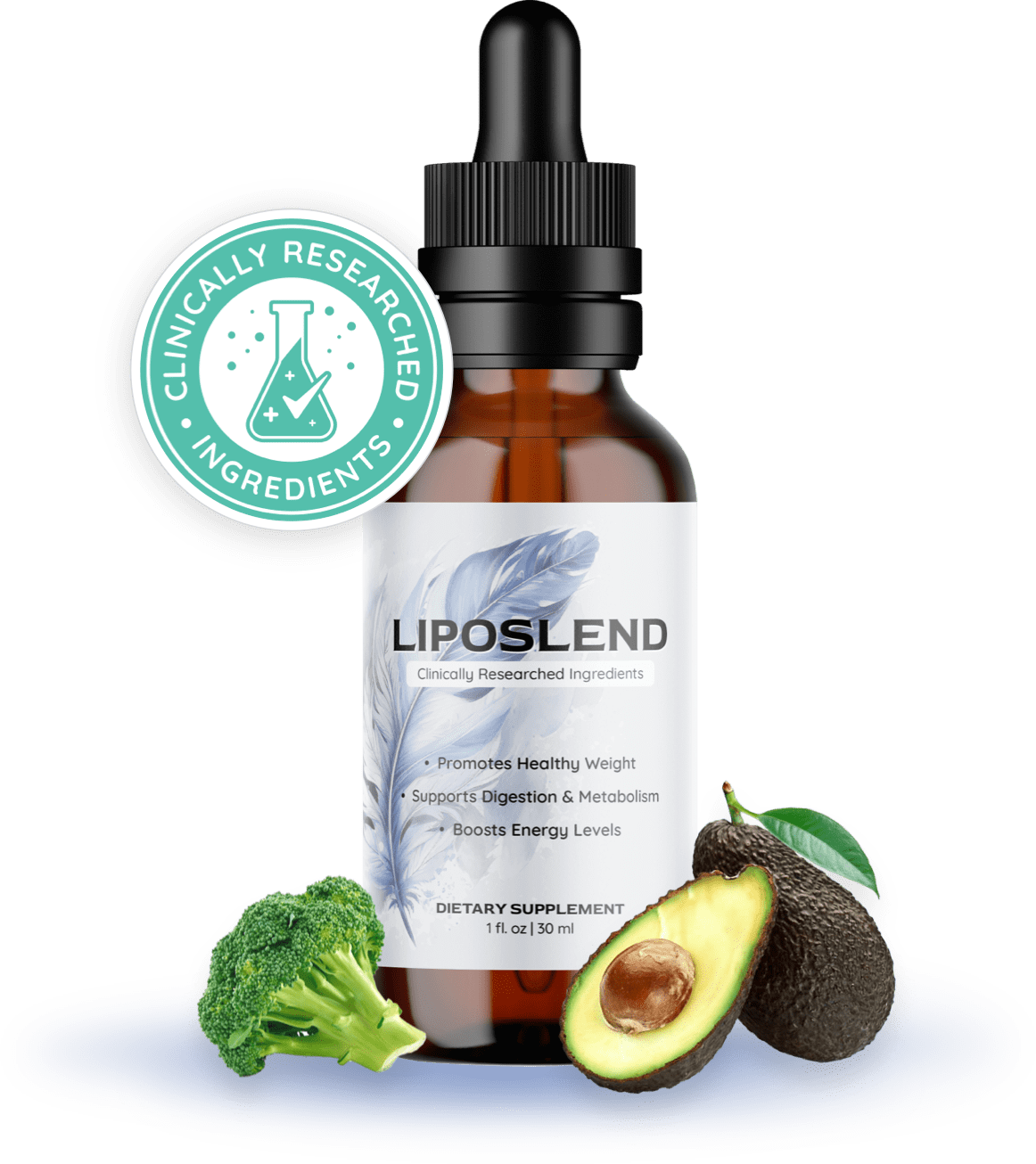
LipoSlend: the bottle we inspected doesn't match what the website sells
An independent check of LipoSlend's liquid-drop formula found a hard conflict between the ingredients printed on a physical bottle and the ingredients the seller currently advertises online — on top of a cluster of near-identical "official" domains and billing-complaint patterns worth knowing before you order.
The physical bottle we examined lists a botanical blend that shares zero ingredients with the formula currently advertised on the brand's own sales page.
Nothing on the seller's own website names who actually manufactures LipoSlend. The name printed on the physical bottle's label does not appear anywhere on the site.
We found more than a dozen near-identical "official" LipoSlend domains currently live (variations like us-liposlend.com, liposlendd.com, liposlend.us, and others), a pattern typical of high-churn affiliate promotion rather than a single stable brand storefront.
Checkout is handled by BuyGoods, a third-party order processor with an independently documented complaint pattern of double charges, unrequested recurring shipments, and slow or partial refund handling — not specific to LipoSlend alone, but relevant to how a purchase here would actually be billed.
What it claims
LipoSlend is marketed as a daily liquid-drop supplement aimed at metabolism and energy support, taken by mouth. The advertising we reviewed leans on a viral "kitchen hack" narrative and dramatic before/after framing that is common in this ad category and that we could not independently verify. We're not repeating the specific claims here because we couldn't source them to anything credible; readers should treat any dramatic transformation story attached to this product as unverified marketing rather than an established outcome.
What's actually disclosed on the physical label
A physical bottle our team examined directly lists the manufacturer as Titan Labs, Coconut Creek, Florida, and names the following ingredients: hawthorn, horse chestnut, grape seed, stone root, motherwort, gotu kola, and butcher's broom, plus a proprietary component labeled "Ormus Supercharged Minerals." That last item is not a recognized clinical or nutritional ingredient category — "Ormus" refers to a fringe, pseudoscientific concept about "monoatomic minerals" with no accepted scientific basis, and the label does not specify what it actually contains.
This is a circulatory-botanical blend, not a formula built around any of the ingredients the brand's own sales page currently promotes. We were not able to independently confirm Titan Labs' business registration or location beyond what's printed on the label itself — we're disclosing that gap rather than presenting the manufacturer name as independently verified.
What the official site currently advertises
On re-checking theliposlend.com directly, the site currently lists a completely different ingredient set: sulforaphane, cissus quadrangularis, pine pollen extract, acetyl L-carnitine, beet root extract, and glucomannan. This matches what was found in earlier research on this product — the mismatch has not resolved or been corrected since.
Pricing as currently listed: one bottle around $69, three bottles around $59 each, six bottles around $49 each, all with stated free U.S. shipping on multi-bottle orders. The site advertises a 60-day, no-questions-asked money-back guarantee, "including empty bottles." No manufacturer name, business address, or "distributed by" line appears anywhere on the page we reviewed. Order fulfillment and refund lookup both route through BuyGoods, a third-party payment processor, rather than a manufacturer-branded contact.
The mismatch, plainly
Put the two lists side by side and there is no overlap at all: not one ingredient printed on the physical bottle appears in the current website's advertised formula, and not one ingredient advertised on the website appears on the bottle. That's not a labeling nuance or an old-formula/new-formula update — it's two entirely different products sharing one brand name and one bottle.
We'll also note, for transparency: the specific circulatory-botanical combination on this label — hawthorn, horse chestnut, grape seed, stone root, motherwort, gotu kola, and butcher's broom — is not unique to this product. We've seen the identical combination, in the identical order, on differently branded supplement labels elsewhere. Reusing one contract manufacturer's stock formula under multiple brand names is a known practice in this industry; it isn't automatically evidence of fraud on its own, but paired with an advertised ingredient list that doesn't match the physical product at all, it raises the question of which formula — if either — a given bottle will actually contain.
A separate naming concern
Independently of the label mismatch, we found consumer-protection writeups describing an ad campaign for something called "LipoSlend Drops" that uses fabricated network and celebrity-doctor endorsements, fake review counts, and a different ingredient story entirely (built around black salt, quercetin, and berberine) routed through unrelated landing-page domains. We could not confirm whether this is the same seller as theliposlend.com, an affiliate running unauthorized ads for it, or an unrelated party riding on a similar name. We're flagging the overlap rather than asserting a connection we can't verify — but either way, it means search results and social ads for "LipoSlend" currently mix at least two different claim sets and possibly different sellers, which is its own reason for caution.
Evidence for the ingredients
Botanicals on the physical label
Per NIH's National Center for Complementary and Integrative Health, horse chestnut seed extract has some human research behind it for chronic venous insufficiency (poor leg-vein circulation) specifically, and hawthorn has been studied mostly for heart and blood-vessel use with NCCIH describing the overall evidence as limited. We found no comparable NCCIH-level clinical evidence for grape seed, stone root, motherwort, gotu kola, or butcher's broom at the doses used in a product like this, and "Ormus Supercharged Minerals" isn't a defined, testable ingredient at all.
Ingredients advertised on the website
Some of the advertised ingredients have limited human research in other, unrelated contexts — glucomannan and short-term fullness, beet root and exercise blood flow, for example. But because none of this matches what's printed on the bottle we examined, that research doesn't tell a buyer what they'd actually be consuming if the product they receive matches the physical label instead of the website.
Made-in-USA claim, bundle pricing & shipping — re-verified
"Made in the USA" claim
Not found. Re-checking theliposlend.com directly, we found no claim anywhere on the page that LipoSlend is "Made in the USA" or naming any country of manufacture. This is consistent with the broader manufacturer-disclosure gap noted above — the site doesn't name a manufacturer or a location for one.
Bundle pricing, tier by tier
Confirmed at re-check: $69 for 1 bottle, $59 per bottle on the 3-bottle tier, and $49 per bottle on the 6-bottle tier — unchanged from our earlier research. These are the per-bottle prices shown on the vendor's own bundle graphics; the page's on-screen order-total field is populated by checkout scripting rather than shown as static text.
Free shipping — which tier
The vendor's page states "Every Order Comes With FREE Shipping Too!" and its shipping table lists "United States | FREE" against all three bundle tiers. So on this vendor's own page, free shipping applies to every tier for U.S. orders — not just multi-bottle bundles. International orders (Canada, UK, Ireland, Australia, New Zealand) are shown with a flat $15.95 shipping fee.
Our take
Given a manufacturer that isn't named on its own sales page, an advertised formula that doesn't match a physical bottle of the product, and checkout routed through a processor with documented refund complaints, we can't point you to a specific bottle of this product with confidence in what's inside it. If you're specifically interested in the circulatory botanicals named on the physical label — hawthorn, horse chestnut, grape seed, and related ingredients — we'd suggest browsing options from brands that publish a complete, matching ingredient panel on both their packaging and their own product page.
Browse circulatory-support formulas on AmazonSources checked for this report (accessed August 2026):
- Physical LipoSlend bottle and printed label, examined directly by our research team
- theliposlend.com — official product site: ingredient list, pricing, guarantee terms, BuyGoods checkout
- malwaretips.com — "LipoSlend Drops" consumer-warning writeup (describes a differently-sourced ad campaign using the same product name)
- PissedConsumer — BuyGoods complaint archive (billing/refund complaint patterns for the processor used at checkout)
- NCCIH — Horse Chestnut: Usefulness and Safety
- NCCIH — Hawthorn: Usefulness and Safety